
Trigger Warning: Death, Suicide, Drug Addiction.
Despite being a fan of pro-wrestling for about eight years now, my knowledge of wrestling history is patchy at best. As such, I knew very little about the Von Erich family beyond the legend their name carried, and so I was keen to see their biopic when it was released in cinemas in February 2024. I had already heard of the Von Erich “curse” and reasoned that a biopic where nothing of consequence happened would be very boring to watch, but I still wasn’t emotionally prepared to get a glimpse of what this family went through, and how disability seemed to follow them throughout their lives.
I’m not sure if discussion of the events of a biopic counts as “spoilers”, but if you don’t want to know about the events of the film, save this page and come back to it later!
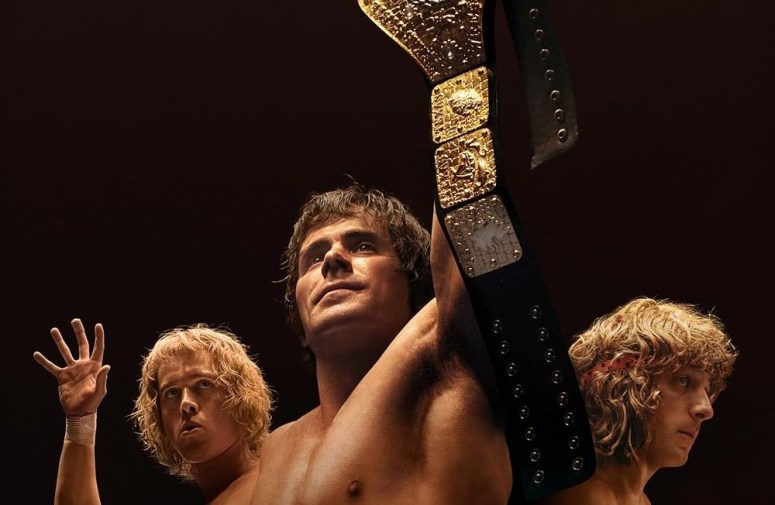
The first victim of the curse is the patriarch of the family himself, Fritz Von Erich, who suffered a career-changing injury that forced him out of American football and into professional wrestling in the 1950s. He made a name for himself in the squared circle with the finishing move that is the film’s namesake, the Iron Claw, gripping someone’s scalp and forehead with an outstretched claw hand, and pinning them to the mat. While Fritz was successful in his wrestling career, he never got to hold the grand prize of his dreams – the world heavyweight championship – and so his dream was passed onto the six sons he had with his wife Doris; Kerry, Kevin, David, Chris, Mike and Jack. Only one of his sons is alive today.
Jack, who died during childhood, only makes a brief appearance in the biopic, and Chris, who died by suicide as a young adult, is not mentioned at all. The other four, however, feature prominently in the film.
David was the first of these to die, alone in a hotel room in Japan after trying to power through the pain of a ruptured intestine instead of seeking medical aid.
Mike’s story was the one that affected me the most, as it bore some striking similarities to my own. Instead of meningitis, Mike would develop Toxic Shock Syndrome after undergoing a routine surgery, and the resulting fever left him with a chronic disability that made physical activity almost impossible. Having always had more of an aptitude for music than sport, he seemed to resent the disability he acquired from a wrestling injury and struggled to adapt. He committed suicide by overdosing on medication, something I attempted when still learning to adapt to my own disability.
Kerry’s death seemed to come out of nowhere. He lost the lower part of his leg in a motorcycle accident in 1986. In recent interviews, Kevin has stated that Kerry only lost the leg when he pushed himself too hard while recovering from his other injuries. With a prosthetic leg he managed to keep wrestling, using boots and knee pads to hide his disability. He would go on to have some success in wrestling, holding the illustrious WWF (now WWE) Intercontinental Championship in the early 90s. We had a disabled WWF champion in 1991 – and we never even knew it.
Unfortunately, despite his apparent success, behind closed doors Kerry still struggled to cope with his acquired disability, developing a painkiller addiction and committing suicide in 1993.
Kevin is the only brother to survive but still feels the effects of the alleged “curse”, struggling immensely with grief and depression, relying heavily on his wife Pam to cope.
As I left the cinema, I realised that one thing about the way disability is portrayed in the film really stood out to me; the lack of inspiration porn. Ironically, I think this came about because the film-makers didn’t realise this was a film about disability, and seeing it as incidental meant they didn’t feel the need to sugar-coat it or make inspiring montages. It was extremely refreshing to see a story about disabled people that didn’t portray us as heroes simply for existing.
There are still issues with the way disability is portrayed in this film, likely also as a result of disability being viewed as incidental to the story. The primary issue is that a disabled actor was not chosen to portray Kerry; if you can CGI a foot out, you can CGI a foot in for scenes where a prosthetic would be obvious.
The Iron Claw also has some other important messages about toxic masculinity, the harm caused by being told to “man up” or “push through”, and the dangers of trying to force your dreams and ambitions on someone else. These are issues that plague the wrestling industry to this day, and I hope that the wrestling fans in the audience are able to see past the surface level biopic and take some of these messages to heart.
Similarly, I think this film also has much to offer even if you aren’t a wrestling fan. If nothing else it shows a more human, Raw (pun absolutely intended) side to the business that might help break down some of the negative stereotypes that people have about wrestling.
The Iron Claw is not just about wrestling. It’s about disability, toxic masculinity, and relationships.
And if that doesn’t convince you, perhaps the fact that Zac Efron takes his shirt off approximately every 0.3 seconds will.
 Diary of a Disabled Person.