

Disabled people often find ourselves accused of being given an unfair advantage when accommodations are made to allow us to navigate the world as our able-bodied counterparts do. This often results in long and hard-fought battles to get those accommodations, a significant barrier that can put people off trying to get them in the first place. Application processes are often grueling and incredibly invasive of our privacy.
Truth be told the problem of trying to explain why accommodations are perfectly fair is not exclusive to disability, with policies that promote the inclusion of women, LGBTQAI+ and BAME people often being lauded as unfair too (just look at how people react whenever a role previously portrayed by a white actor is picked up by someone who isn’t a pasty Caucasian), but my personal experiences of this conflict almost always pertain to disability and so this is how I will frame my perspective.
Recently, in trying to explain to someone how such accommodations do not give disabled people an unfair advantage, I found myself using the following metaphor.
Imagine an athletics racetrack, with concentric laps getting longer the further you move away from the central space. If, in a race of one lap, all the runners started in a straight line, those on the outer tracks would have further to run and so the odds of them winning would be greatly stacked against them. It would not be fair.
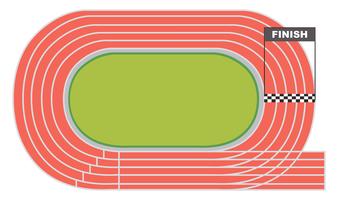
Instead, the starting line for each track is staggered, increasingly so with each concentric ring away from the middle, so that the runners all have the same distance to cover. From the perspective of each runner on the track, it may look like some are getting to start further forward and thus have an advantage, but with a birds-eye view it becomes clear that all the runners are being treated equally.
The runners are disabled people, each ring of the track is the task before us, and the distance the starting line is staggered is the level of accommodation needed for equality to be reached.
This metaphor goes beyond a binary comparison of able-bodied and disabled people, but touches upon the fact that disabilities are varied (like the length of the track for each runner) and therefore different disabled people will need different levels of accommodation.
The accommodations often given to disabled people, usually only granted after a substantial battle which this metaphor overlooks, are simply a matter of levelling the proverbial playing field. It is not, and never has been, about giving us unfair advantages despite what you may have previously thought.
If once equality has been granted the disabled people are showing you up, this is merely a reflection of how while you whine about how unfair it all is, we’ve crossed the proverbial finish line.
 Diary of a Disabled Person.